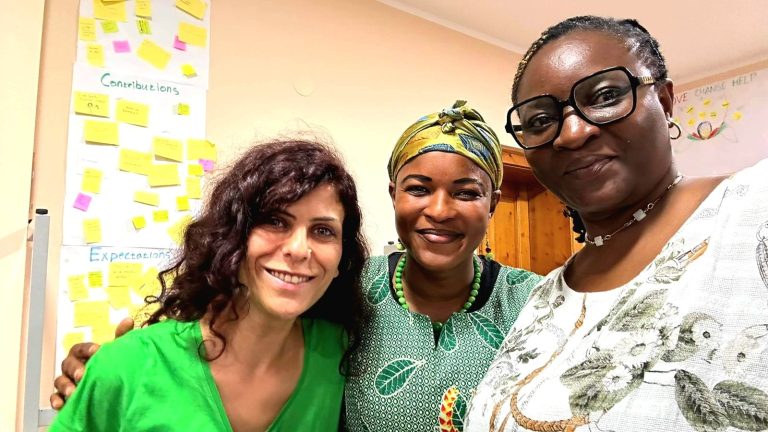
In an inspiring dialogue between two women dedicated to social justice, Nassira Camara, an intercultural mediator from Mali living in Italy, and Samar Zughool, an intercultural trainer from Slovenia originally from Jordan, shared their insights on mentorship, gender advocacy, and integration. Their discussion revealed the transformative power of mentorship and intercultural mediation in empowering migrants, asylum seekers, and survivors of gender-based violence.
The Role of Intercultural Mediation
Nassira Camara’s journey into intercultural mediation began with her passion for supporting migrants and refugees.
“I am an interpreter, mediator, and founder of several organizations, including Malimuso Odibi, the Malian Women’s Association in Italy, and Mali ODB, my local NGO in Mali,” she shared.
Her work in mediation is a bridge between communities, helping newcomers navigate legal, social, and cultural barriers.
Samar Zughool, deeply engaged in intercultural training, emphasized the participatory learning approach in her work.
“This program creates a participatory learning environment where we exchange knowledge through peer-to-peer learning,” she explained.
By bringing people from different cultural backgrounds together, they develop competencies essential for social and labor integration.
Mentorship and Empowerment
Both women discussed the critical role of mentorship in empowering individuals. Nassira reflected on her own journey, admitting that before this program, she was unaware of the structured concept of mentorship.
“Mentorship was something I was doing without knowing what it was. This program helped me understand who a mentor is and what it means to guide and support others,” she said.
Samar elaborated on the power of experiential learning.
“People might forget what you say or do, but they will never forget how you made them feel. That is why creating meaningful experiences is essential in mentorship,” she noted.
She believes that mentorship is a two-way process, where both mentor and mentee grow and learn from each other.
Challenges and Opportunities in Social Integration
Both Nassira and Samar addressed the systemic challenges faced by migrants and refugees.
“Helping migrants means understanding their situation first. It’s not enough to speak the language; you have to truly understand their struggles and guide them through integration,” Nassira stated.
She emphasized that intercultural mediators act as bridges between society and migrants, ensuring they receive the necessary support to adapt and thrive.
Samar highlighted the barriers to social and labor integration.
“In the heart of challenges and barriers, there are opportunities. By identifying these, we can create pathways for migrants to become self-sufficient members of society,” she explained.
She shared her work mentoring individuals through the employment office in Slovenia, providing support to both locals and newcomers.
Intersectional Feminism and Gender Advocacy
One of the key topics in their conversation was gender advocacy, particularly for women in refugee and migrant communities. Nassira spoke about her advocacy for women’s rights, especially those facing domestic and gender-based violence.
“I fight for women who have endured difficult conditions. My goal is to empower them so they can become leaders in their own right,” she said.
Samar, with her background in gender studies, echoed the need for an intersectional approach.
“Intersectional feminism is crucial. We need to acknowledge that the struggles of migrant women differ based on various factors such as culture, socioeconomic status, and systemic discrimination,” she stated.
The two women discussed their plans to collaborate on a training program in Italy focusing on intersectional feminism and gender advocacy.
Building a More Inclusive Future
The conversation between Nassira and Samar highlighted the importance of intercultural understanding, mentorship, and gender advocacy in building inclusive societies.
Nassira shared her vision for the future: “We need to get out of binary narratives of ‘us’ and ‘them’ and find common ground. Integration is not just about policy; it’s about people connecting and understanding each other.”
Samar added, “Mentorship and intercultural mediation are not just professional roles; they are responsibilities. We must continue to create safe spaces for learning, sharing, and growth.”
As they concluded their discussion, both women expressed their excitement for future collaborations. “I am looking forward to working with you on intersectional feminism in Italy. This is just the beginning,” Nassira said.
“Yes! Next stop: gender mainstreaming and intersectional feminism in Italy,” Samar responded enthusiastically.
Their powerful exchange serves as a testament to the impact of mentorship, advocacy, and intercultural mediation in transforming lives and communities. By fostering understanding and collaboration, they continue to break barriers and build pathways for a more inclusive and just society.
